Parastomal Hernia: Classification and Repair
A parastomal hernia is an incisional hernia that forms next to a stoma, where the bowel passes through the abdominal wall. Repair requires a mesh — direct suture is discouraged by the guidelines — and the techniques that lateralize the bowel loop (Sugarbaker, sandwich, Pauli, funnel mesh) have lower recurrence rates than the keyhole technique.
A parastomal hernia is the most frequent complication of stoma creation: the opening made in the wall to bring out the bowel progressively widens and the abdominal content pushes beside the loop. Its true frequency is high: in series with systematic radiological follow-up it exceeds 30% already at one year — in the control group of the 2024 randomized Chimney trial it was 37% at 12 months — and grows with the duration of the stoma.
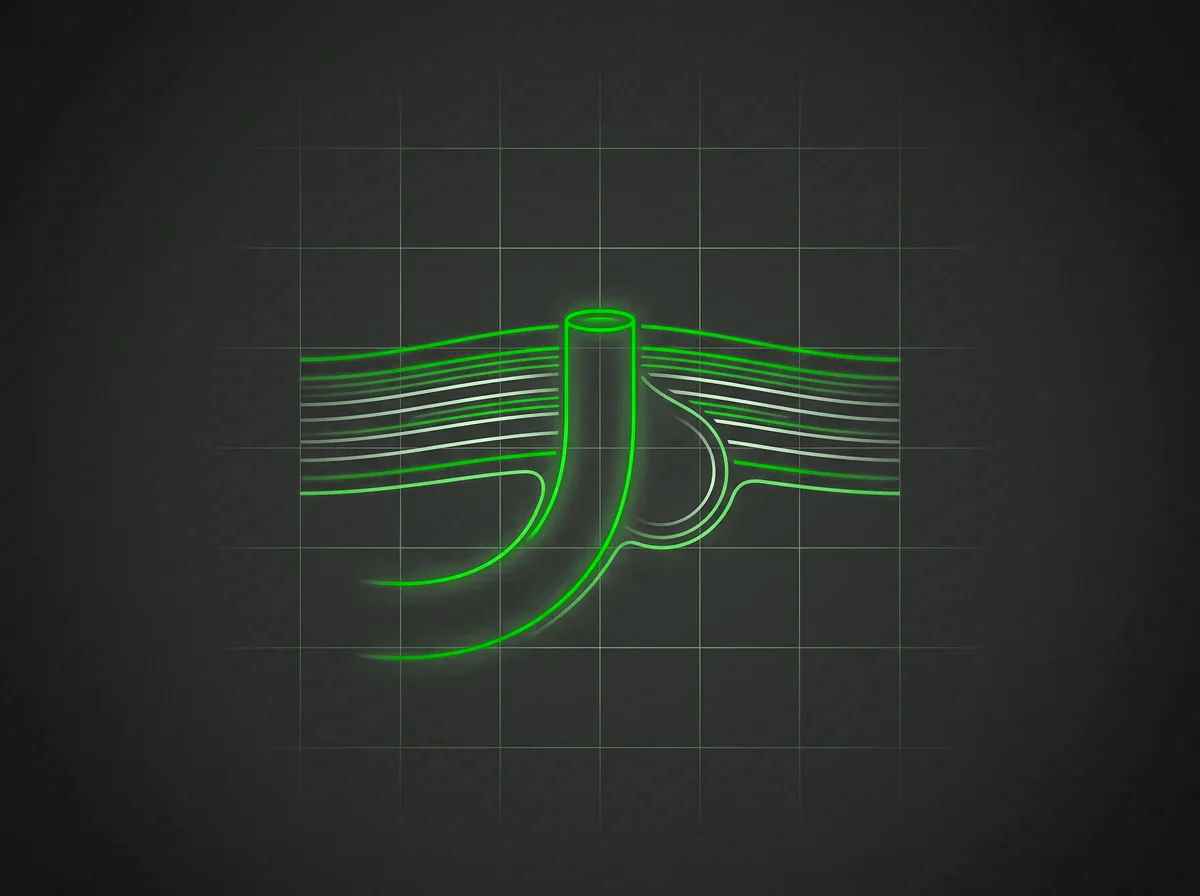
The classifications
The description of parastomal hernias has a long history: anatomical in Rubin and Devlin (1985), clinical-radiological in Devlin and Kingsnorth (1998), more detailed in Gil and Szczepkowski (2010). The current reference is the 2014 European Hernia Society classification, created to standardize reporting and feed the European EuraHS registry: only two variables, the maximum defect diameter (5 cm threshold) and the presence of a concomitant incisional hernia.
| EHS type | Defect diameter | Concomitant incisional hernia |
|---|---|---|
| I | ≤5 cm | Absent |
| II | ≤5 cm | Present |
| III | >5 cm | Absent |
| IV | >5 cm | Present |
Each type is completed by the letter P (primary hernia) or R (recurrence after previous repair). The 2018 EHS guidelines recommend its use in research and practice, while noting that no parastomal hernia classification has so far been clinically validated: classification guides description, not yet technique selection.
General principles of repair
The 2018 European Hernia Society guidelines fix three points: direct suture should be avoided because of the high recurrence rate (strong recommendation); in laparoscopic repair a mesh without a hole is preferable to a keyhole mesh; and in prevention, when fashioning an elective permanent end colostomy, a prophylactic synthetic non-absorbable mesh is recommended.
The keyhole technique
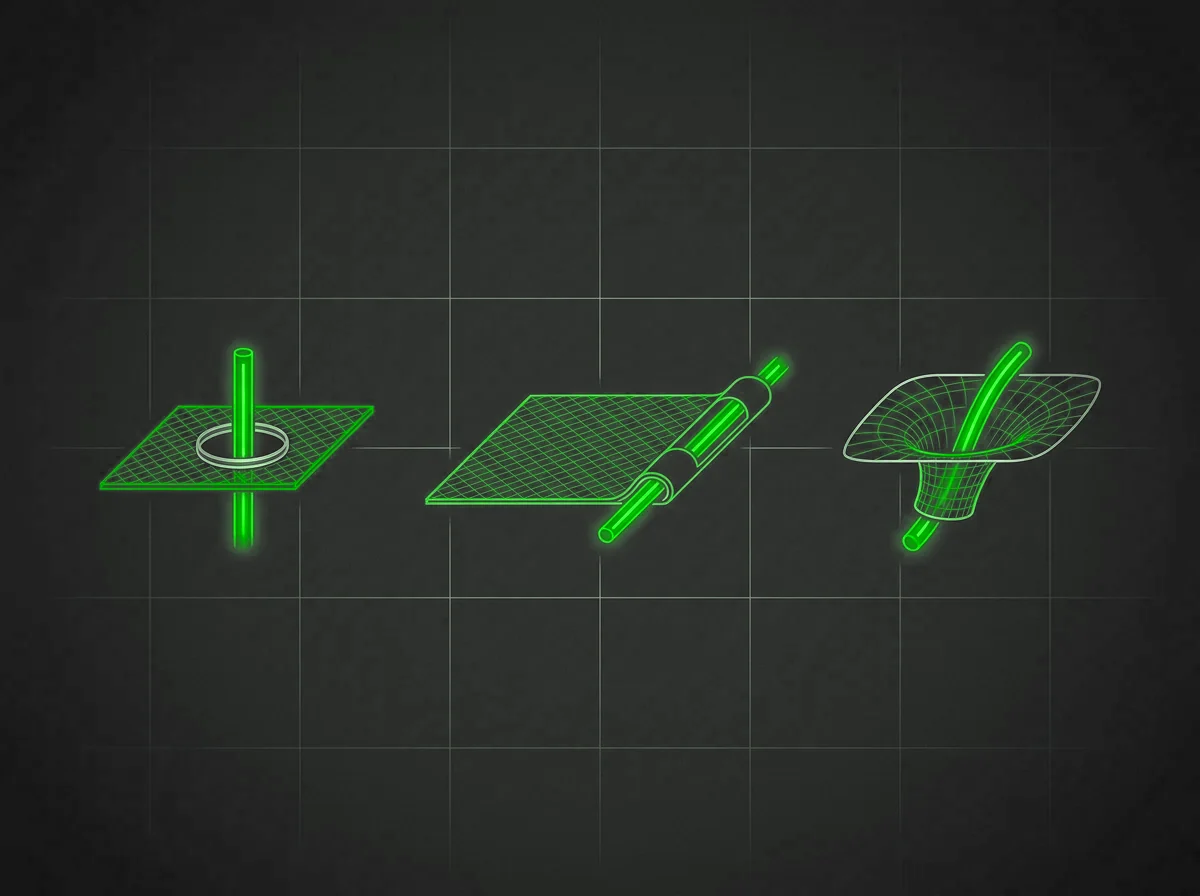
The most intuitive: an intraperitoneal mesh with a hole — or a slit — in the centre, embracing the stoma loop like a collar. Its weak point is precisely that hole: over time it tends to widen or deform, and the hernia recurs through it. The most recent pooled data (2023 meta-analysis) attribute to keyhole a recurrence of 24.1%; already Hansson's 2012 meta-analysis showed a significantly higher recurrence risk than the Sugarbaker technique (odds ratio 2.3).
The Sugarbaker technique
Described by Paul Sugarbaker in 1985, it is the historical reference: the intraperitoneal mesh has no hole and the stoma loop is made to run laterally along the edge of the mesh for at least 5 cm, as in a covered tunnel. Abdominal pressure presses the loop against the mesh instead of towards the defect. Pooled recurrence is about 9%; the points of attention are the contact between mesh and viscera — which requires anti-adhesive composite meshes — and possible kinking of the loop.
The sandwich technique (Berger)
Proposed by Dieter Berger in 2007, it combines the two logics in two overlaid meshes: a first anti-adhesive mesh with a 1–1.5 cm central opening around the loop (keyhole component), and a second larger mesh that lateralizes the loop on top of the first (Sugarbaker component). In the 2023 meta-analysis the sandwich technique had the lowest recurrence among the classical laparoscopic techniques (3.5%), against a reported morbidity of 13.2%.
The Pauli technique (TAR + Sugarbaker)
The repair described by Eric Pauli brings the mesh into the retromuscular plane instead of the peritoneum: after adhesiolysis — often robot-assisted — a posterior component separation (TAR) is performed and a pocket is developed that extends at least 10 cm lateral to the stoma. The loop is completely freed from the hernia sac and lateralized in a Sugarbaker configuration between the layers of the wall; the mesh (18–20 cm) occupies the retromuscular pocket in front of the posterior fascia. If the wall around the stoma is damaged, the stoma can be revised or relocated in situ. Reported mid-term recurrence is around 5%; the technique is not indicated in small-bowel stomas with a short mesentery, where lateralization is limited.
The PVDF mesh with central funnel (DynaMesh IPST)
The keyhole logic revised in three-dimensional form: the polyvinylidene fluoride (PVDF) mesh has a central funnel — a funnel 2 cm in diameter and 4 cm long — through which the loop passes, guided without kinking; the cap is fixed to the wall intraperitoneally, usually with a double crown of spiral tacks, in the so-called chimney configuration. A variant, IPST-R, has a prefabricated slit with reinforced edges and a 3 cm funnel to fit an already fashioned loop.
The data: in prevention, the randomized Chimney trial (JAMA Surgery 2024) showed a reduction of CT-confirmed parastomal hernia from 37% to 10% at 12 months; in repair, a 2024 retrospective series (21 patients) reports a 4.8% recurrence at a mean follow-up of about 22 months, and urological series on ileal conduits a 7% recurrence at 29 months. These are still young numbers, on small series: read them with caution.
How to choose
| Technique | Mesh plane | Reported recurrence | Note |
|---|---|---|---|
| Direct suture | — | High | To be avoided (2018 EHS guidelines) |
| Keyhole | Intraperitoneal | ≈ 24% | Simple, but the hole is the critical point |
| Sugarbaker | Intraperitoneal | ≈ 9% | The historical reference |
| Sandwich (Berger) | Intraperitoneal, double mesh | ≈ 3.5% | Higher morbidity |
| Pauli (TAR + Sugarbaker) | Retromuscular | ≈ 5% | Requires TAR; robotics useful |
| PVDF funnel mesh | Intraperitoneal | 4.8% (initial series) | The funnel guides the loop; young data |
The concrete choice depends on the presence of an associated incisional hernia (EHS types II and IV), the size of the defect, the type of stoma and the patient's condition, and is always made in the assessment of the individual case. When the defect coexists with an extended incisional hernia, the repair integrates with the midline reconstructive techniques.
Frequently asked questions
What is a parastomal hernia?
A hernia that forms next to a stoma: the opening in the wall created for the bowel widens and the abdominal content pushes beside the loop. It is the most frequent complication of permanent stomas.
When should a parastomal hernia be operated?
When it causes problems: pain, issues with appliance adhesion, difficulty managing the stoma, or complications such as obstruction or strangulation. Small asymptomatic hernias can be kept under observation.
Is it safe to place a mesh next to the bowel?
Meshes used next to viscera are built for this purpose (anti-adhesive composite material or PVDF), and retromuscular techniques such as Pauli's avoid contact with the bowel altogether. The type of mesh depends on the chosen technique.
- European Hernia Society — classification of parastomal hernias (Śmietański et al., Hernia 2014)
- EHS guidelines on prevention and treatment of parastomal hernias (Stabilini et al., Hernia 2018)
- Hansson B.M. et al. — meta-analysis of repair techniques (Ann Surg 2012)
- 2023 meta-analysis: keyhole 24.1%, Sugarbaker 9%, sandwich 3.5%
- Sugarbaker P.H. — peritoneal approach to prosthetic mesh repair of paraostomy hernias (1985)
- Berger D. — sandwich technique for parastomal hernia (2007)
- Pauli E.M. et al. — retromuscular parastomal hernia repair with TAR (2016)
- Chimney randomized trial — funnel mesh in prevention (JAMA Surgery 2024)
- 2024 repair series with PVDF funnel mesh (DynaMesh IPST)